Another Yashica
For better, for worse, old used cameras are always a risk, says he, with a pair of duff Olympus XA2 on the bench, one of which is in bits. For richer, for poorer, generally the latter with me, another Yashica has arrived. I didn’t particularly need another (told you always for poorer), but this one had caught my eye and I’d been watching it on eBay for a few weeks. The price dropped eventually, to a point where I thought; why not.
No lens, no bag of assorted accessories, working or otherwise, or a bag for that matter, just a camera body. The requisite lenses I’ve already acquired. I’ve three decent primes now, plus a zoom and they will be dealt with on another page soon.
What’s arrived is an FX-103 Program, and in essence it’s a later update to the FX-D, launched in 1985, five years after the FX-D appeared. Both share some commonality with their more expensive Contax brethren of the same year of course; as the FX-D is to the Contax 139, the FX-103 is to the Contax 159MM.
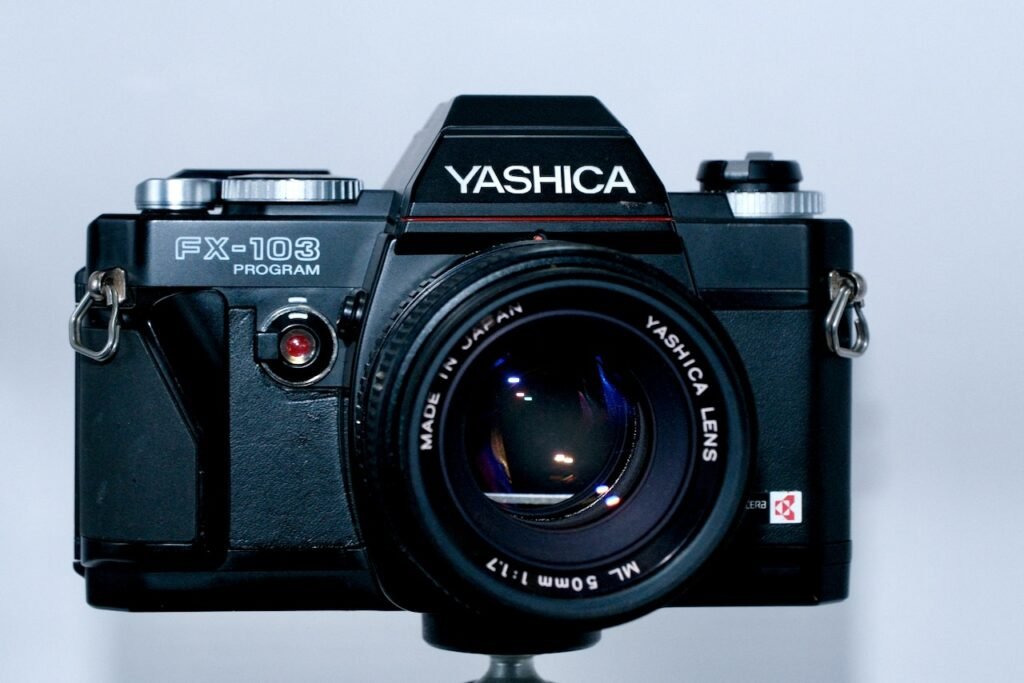
In both cases, the Yashica is a moderately “de-featured” version for the consumer market, when compared with the reciprocal professionally orientated, and more expensive, Contax. In a similar way to maybe Audi vs Seat, same group, but you’re paying for the name and features, plus maybe better build quality, even though they often share engines and floorpans.
From a user perspective, the FX-103 Program is definitely a step up from the earlier FX-D. The Program bit in the name being the biggest clue. Aside from the usual aperture priority and manual exposure options, it benefits from two Program modes. In both, you set whichever Yashica lens is fitted to its minimum aperture and Regular Program mode will work out what it thinks is the optimum shutter speed and aperture settings. The High Program mode, simply maintains a slightly faster shutter speed than Regular, and is better when using telephoto lenses (aka long lenses) where camera shake can become a problem as shutter speeds drop, than with lighter and smaller lenses.
I have to admit, I’ve had two Olympus film cameras which both had a Program mode, and never really bothered to use it on either. I doubt I’ll be any different with the Yashica, but I might give it a try, partly just to see if it works.
The rest of the base specification is very similar to its older brother, including what was becoming a quite pedestrian 1/1000 second top shutter speed, especially when compared with the competition from other manufacturers. Yet this also includes Contax (1/4000) and even Yashica’s own FX-3 Super 2000; the 2000 referring to its fastest shutter speed.
It may seem trivial, but one improvement I do like over the FX-D, is that the metering activates on a half press of the shutter button, and stays on, like every other camera of the era I’ve ever used. This, as opposed to the needing to press the middle of the front mounted self-timer lever on the FX-D, which always felt a bit odd. The indicator on the FX-D did illuminate on half press, but you had to keep your finger on it.
The two biggest improvements though are TTL flash metering and a much brighter viewfinder. The latter is bitingly obvious as soon as you put the camera to your eye, definitely brighter than the FX-D and it’s certainly one of the best I’ve used regardless of brand. It displays no more information than the earlier model, except a P at the top of the shutter speed numbers when Program mode is engaged and saldy, unlike the Contax, doesn’t show and indication of the aperture that’s set either. But it’s really nice.
TTL flash meter works with the matching CS-203 flash unit (Typically, the Yashica flash unit which appeared alongside the last FX-D I bought, isn’t a 203, but at least it works!) and it also works with any of the Contax TLA-series flash units. Having used Olympus film cameras back in the day, all of which had TTL flash metering, since 1975 with the launch of the OM-2, it does make life easier.
Size wise, the FX-103 is about the same width as the FX-D, but a good few millimetres taller, certainly on the pentaprism housing to the top of the hot-shoe, where it’s very noticeable. Both models are 460g in weight though, so obviously some internal construction differences.
It’s not all positives though. For some reason, the FX-103 loses the exposure lock feature found on the FX-D and on there actuated by turning the self timer lever to the AE-L mark. One other very obvious thing that’s not been improved and has carried over from the older model, is the slightly noisy operation. There’s very little sonic damping of the mirror and it does “clack” a bit more than say the Nikon FG that sadly died, or my Olympus OM 40.
Also on the noise front, the FX-103 accepts the same FX Winder as the FX-D and also the Contax Winder II, which was originally built for the Contax 139. If the latter is anything like the FX Winder, I won’t be on the lookout for one, and I’ve no plans to shoot wearing ear defenders to use either of them.
Another “feature” that’s not changed over the years, is the inability of Yashica’s camera coverings to stand the test of time. While many manufacturers can still look pretty good even after 40+ years, the FX-103 arrived bearing a rather sticky covering, though not bereft of leathery surface for a change, and like all the previous Yashica’s that have passed this way.
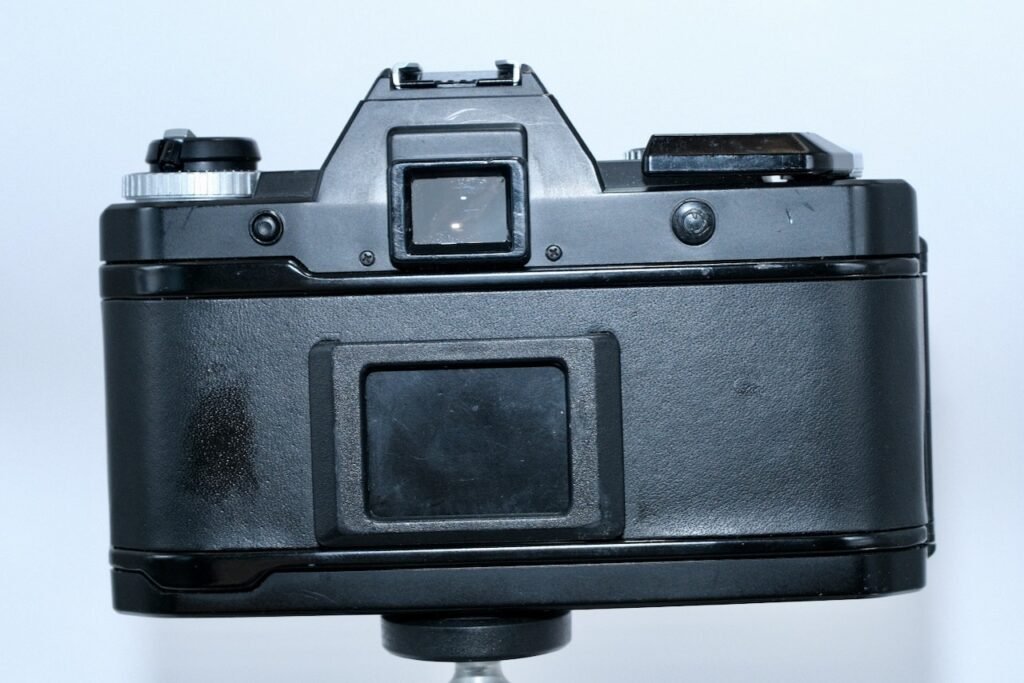
Oddly, the nicely sculptured grip that’s part of the body, so no need to source an add-on one like the Nikon FG/FG-20, is rubber covered and perfectly fine. Obviously, it’s all down to Yashica’s choice of leathery stuff, regardless of it being a Yashica or a Contax I may add, both suffer!
A new skin, standard black for a change, was duly ordered from Aki-Asahi to get the camera body looking something like. Lucky for me though (or not, as I’d already ordered a set of light seals with the new skin before the camera arrived), it looks like someone has renewed the light seals already.
Now why they didn’t bother with the mirror buffer, which was as tacky as usual, I’ve no idea. With enough spare foam around from previous renovations, a replacement for that has been cut and fitted. This predominantly to stop any foam bits dropping onto the pristine viewfinder screen. Worryingly, using a foam off-cut means I’ve enough new light seals to do 3 more FX-D…….
Am I impressed? Yes, probably more than I expected. It’s not a huge upgrade over the FX-D, but the viewfinder easily seals the win on its own. As you can see from the photos, the neat little grip on the front of the body, and mentioned above, for me is also a winner, improving the handling quite nicely.
For a grand total of about £35, I definitely consider this one as a result.
However……I think, he says, this is it on the Yashica SLR buying journey for me as well (despite a stash of seals).
An all manual FX-3, or FX-3 Super 2000…maybe, maybe not, but they are at least cheap. A Contax, just to see if they really are any better, doubtful.
A decent 139 quartz, so the other half of the FX-D equation would be just into three figures. If I could find the FX-103 Program’s counterpart, a 159MM, that could cost £500! A more recent Contax Aria, still manual focus, and very nice, would be £300-ish. So I don’t think so on all counts.
The thing is, by 1983, Yashica had been acquired by Kyocera, hence this FX-103 has a little Kyocera badge on it. They duly carried on building both Yashica and Contax branded cameras for an another 20 years, before finally hanging up the skates. During that period, they did manage to produce some stellar models as well! Mostly on the 35mm compact side of things, both Yashica and Contax models, and acquisition of which now will set you back four figures in some cases. It’s all in the glass, as they say.
But beyond the FX-103, Kyocera and most other companies SLR camera styles change, and I’m not a huge fan of any of the later Yashica bodies, the Contax bodies don’t seem to change that much and still look good. Much of this is to do with the increase in the use of electronics, built in auto-winders etc, but especially the arrival of auto-focus, or AF. And AF is a whole different ball game! Even more component and now motor aging, a lot of basically unrepairable electronics to contend with, and more critically for my wallet, another set of lenses to buy! So I’ll pass.