Last In Line (Almost)
Despite saying and thinking I’d reached the end of the road with Yashica’s manual SLRs, I couldn’t turn down a bargain.
Before the camera world went completely auto-focus mad, the last batch of manual focus models from many manufacturers, seemed to adopt a strange half-way house between the long established SLR shape and that which followed and continued into the DSLR era, in terms of styles and materials at least.
Gone was largely all metal construction, and in came polycarbonates with rounded corners. Small silver oxide or mercury batteries were replaced by a quartet of AA or AAA alkaline’s, but at least you can get those virtually anywhere if you need them; or get them at all in the case of the now illegal mercury cells.
The greatly increased power requirements was due to more complex electronics being built in, which provided program exposure modes for a start, while the manufacturers generally included motor driven film advance within the camera body as well.
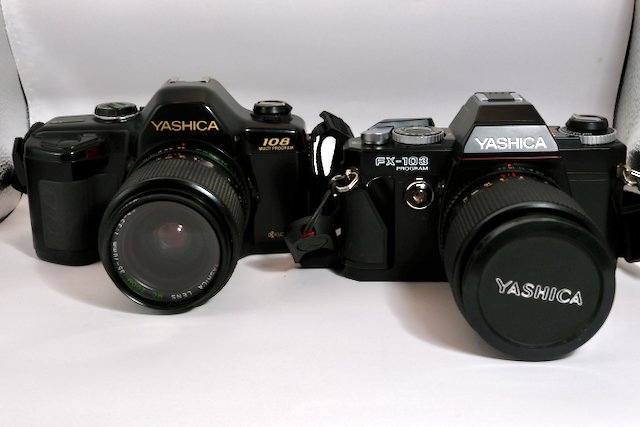
Canon released the T70, Nikon the F301 (N2000 in the USA), while Kyocera – Yashica followed up the manual wind-on 107 with the 108 Multi Program, and 109 Multi Program. No guesses then what’s arrived on my desk…. and henceforth will be called the 108MP.
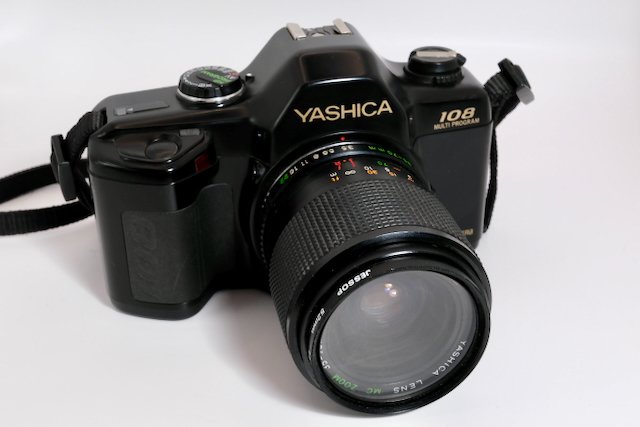
This page could be a review of either the 108MP or 109MP, there’s so little difference specification wise between them, which is hardly surprising given there’s only a year between release dates, 1988 and 1989 respectively. It’s more to do with styling changes between the two, with the later model gaining a deeper grip, a slightly narrower but taller body, as well as being available in black and a strange light metallic gold finish special edition at one point (the term “gaudy” springs to mind).
Thankfully, my 108 MP is just black, though even after briefly handling it, I can maybe see or rather feel why the 109MP replaced it so quickly. A subtly reduced height to the body of the 108MP when compared with the prior FX series means handling is a little odd, as though your little finger is redundant, grasping at fresh air where there should be a camera. Probably made worse if you’ve bigger hands than average.
Kyocera also switched the AAA cells of the 108MP for AA on the 109MP, possibly to improve battery life, and added motorised film rewind, to complement the powered film advance, as opposed to powered advance with manual rewind of the 108MP. Heaven forbid you might have to manually rewind your films. Thankfully, the motor drive is much, much quieter than the clunky add-on unit for the FX-D and FX 103.
Beyond these more or less just packaging features, both models are virtually the same underneath.
They employ DX encoding to set the film speed, with no manual override, hence if you use any film with no DX contacts, the cameras default to ISO 100.
One improvement is the top shutter speed has finally reached 1/2000th of a second, a useful step up from the 1/1000th on FX103 and FX-D. Trouble is, that’s about the biggest highlight! Though another, and a result of the plastic body, is no leatherette to disintegrate and leave the camera looking a mess. The camera front is smooth plastic, with a rubberised grip under the shutter button, while the rear film door is more textured, with a bit of a raised thumb grip as well.
However, the camera body in general is minimalist in terms of controls. The only form of exposure compensation available is a button on the left side of the lens mount that provides +1.5EV. This is OK for back-lit or maybe brightly lit scenes where you want to grab some shadow detail, but with no exposure lock available either, you’re still a little limited.
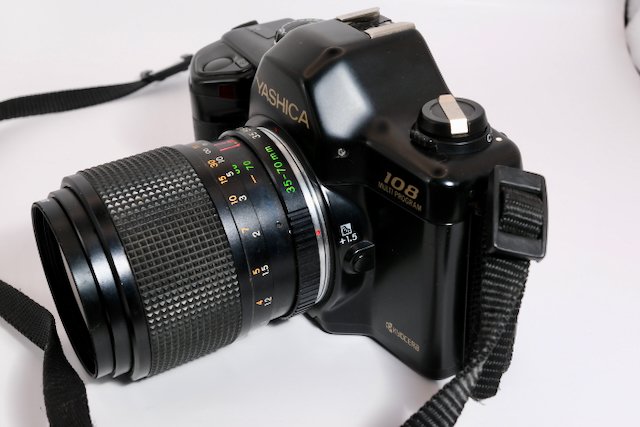
As for other features, there’s not much to report. There’s a small lever marked C or S at the base of the rewind crank, switching the motor drive to single shot or continuous, though the 1or at best 2 frames per second won’t even trouble the humble Olympus Winder 2 I used to use. (The C/S lever migrated to under the program selector dial on the later 109MP, as obviously with powered rewind, there’s no rewind crank)
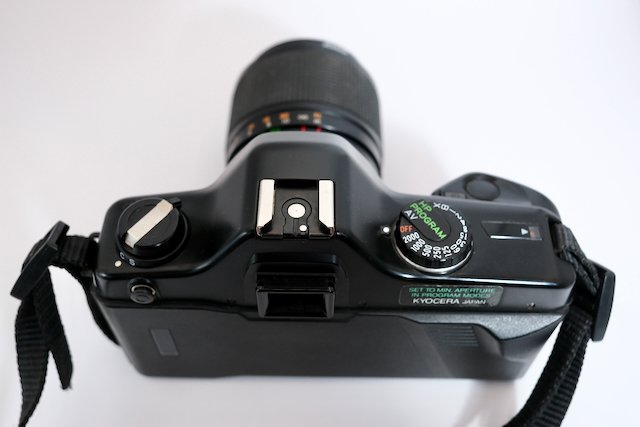
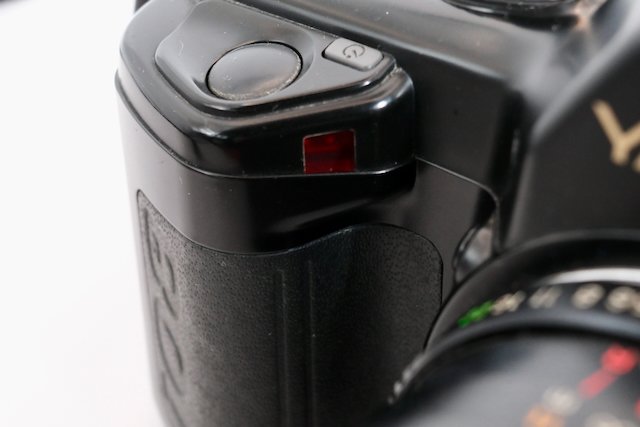
The self-timer previously found on the front of the Yashica bodies, is now a very discreet button nestled at the left side of the shutter button, with a flashing warning LED underneath built into the grip, and other than the rewind crank and program selector dial on the top plate, that’s your lot!
Oddly, to my mind at least, despite gaining 1/2000th shutter speed, both the 108MP and its later sibling have lost more functionality than they’ve gained when compared to the earlier FX 103. As well as the missing exposure compensation and ISO setting override, the viewfinder isn’t a patch on the nice bright affair on the FX103 and there’s no shutter speed indication in the viewfinder either.
The only guide to your exposure in the viewfinder is a single green LED when using aperture priority mode, with a flashing lightning bolt at the top of the right side of the viewfinder suggests you use the flash if the shutter speed is below 1/30th. The indicator becomes solid once the flash is charge.
The green LED blinks if the light level can’t be exposed for when in program mode, or if you’ve not set the lens aperture to minimum, which you need to do in the first place. Thankfully, program mode works on all Yashica manual lenses, and on the 35-70 I tested with, f22 is marked in green to match the program mode lettering on the control dial.
The final viewfinder indicator, is a pair of red triangular LEDs denoting exposure is under or over when you’re in manual mode, both stay on together when exposure is correct.
Another function missing is TTL flash sync when connected to the requisite flash unit, while the sync speed has also dropped to 1/90th from 1/100th on the FX series.
After putting a film through the 108MP and carrying it round while walking my customary furry assistant, I can’t say I’m a huge fan. The ergonomics are OK, the right hand grip is quite comfy, despite the shorter overall body height being noticeable, and my little finger ended up tucked under the camera body, leaving my forefinger comfortably sat on the shutter button.
But it’s the slightly awkward exposure information in the viewfinder that is my biggest gripe. Even the shutter scale found in the viewfinder on the FX-D and FX103, with an LED next to the shutter speed in use is preferable. I suspect this is also why I’m not keen on program exposure modes, very little feedback, or none whatsoever on the 108MP, just that single green LED to say “within parameters”.
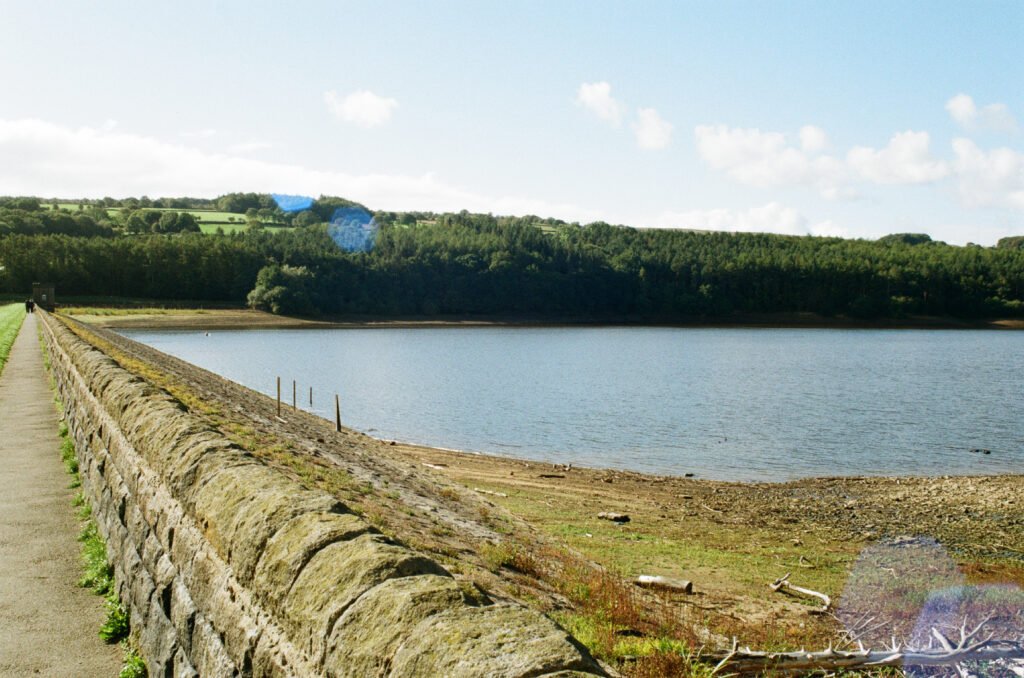
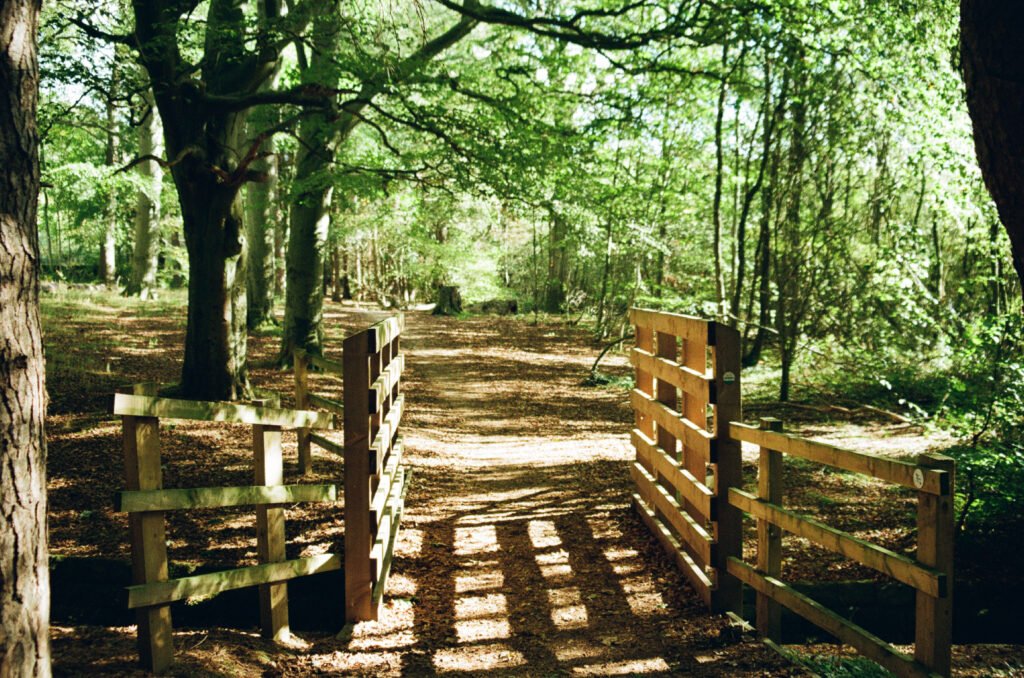
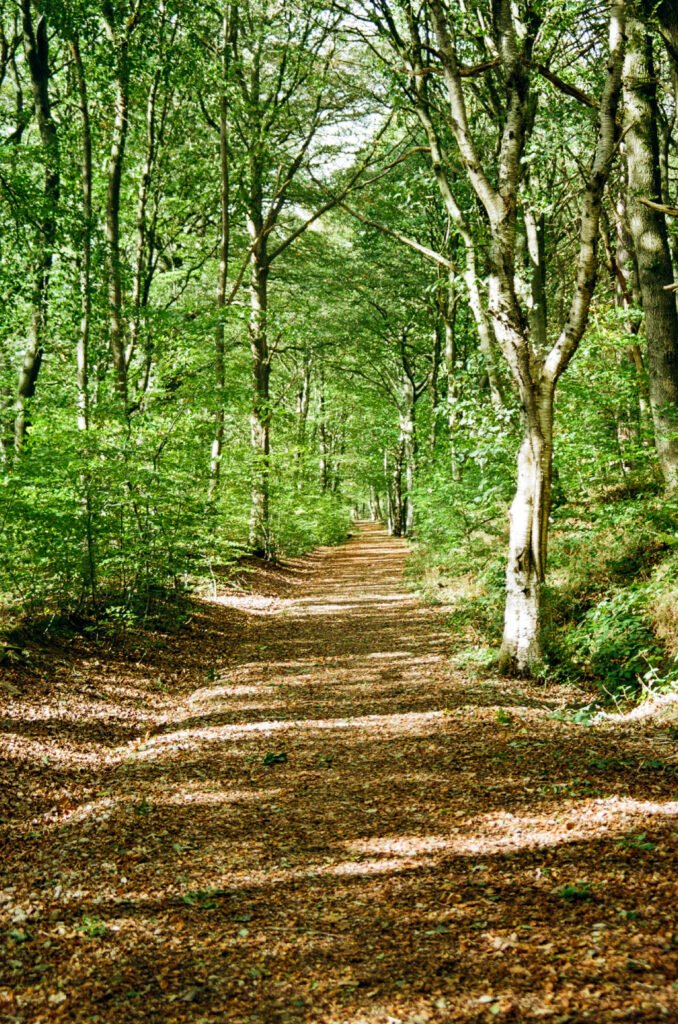
That said, as you can see from the images take with the 108MP below, Program Mode does a decent job of exposure, the first shot is definitely taken using it.
Up or down red LED triangles in manual mode I might get used to, but if you want to gauge just how under or overexposed you are, call me old fashioned, but a swinging needle is still hard to beat. So you can’t really say I’ve been spoilt by all the info available in a modern electronic viewfinder either.
The accompanying Yashica ML 35-70 zoom lens works quite nicely and this type of “standard zoom” largely became the norm, displacing the “nifty fifty” 50mm lens most cameras previously arrived with. From semi-wide to short telephoto, 35-70 provides those buying into a new camera brand a useful range of focal lengths to start exploring with.
Unusually, there’s no Contax equivalent to either the 108MP or 109MP to compare against. The next model in that line was the decidedly more professional orientated, and some would say legendary RTS III, which even now command in excess of £200 body only.
The 108 and 109 Multi-program, were the last of the Yashica branded manual focus models, though the older FX-3 Super 2000 carried on selling well, until that was discontinued in 2003. Unless one of these appears at a suitably bargain price, the 108MP will, this time, be the last Yashica to arrive on my desk.
As an aside, despite launching their own auto-focus 35mm SLR range in 1987, production of these terminated in 1994, following a few years of very poor sales. Some success was had with the three models of all-in-one “Samurai” AF half-frame camera produced from 1987 onwards, whilst a whole swathe of 35mm compacts bore the Yashica and Kyocera name, be they 35mm, APS and eventually digital models. Kyocera remained in the camera industry until 2005, before withdrawing from the market entirely.
The cameras bearing the Yashica name more recently, are unrelated products built in Hong Kong, after the brand name was sold to a Chinese company.